Flowers, Floral Digital Paper: A Practical Guide for Creative Projects
Flowers, Floral Digital Paper refers to a curated collection of high-resolution, printable digital background patterns featuring botanical motifs—roses, peonies, daisies, eucalyptus, and other stylized or realistic floral arrangements. Unlike generic clipart or stock photography, this type of digital paper is specifically designed as seamless, repeatable 12 × 12 inch backgrounds optimized for craft and design workflows. It bridges the gap between traditional scrapbooking materials and modern digital production, offering flexibility without sacrificing print fidelity.
What You’ll Actually Receive—and Why It Matters
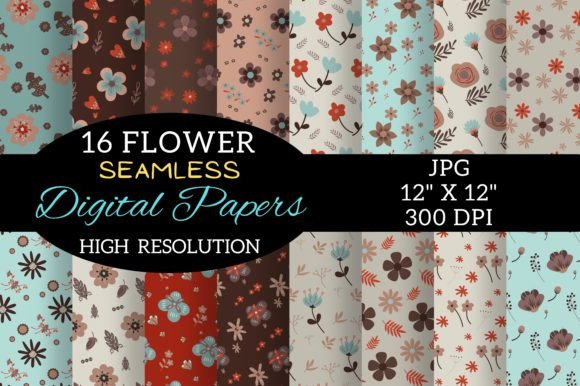
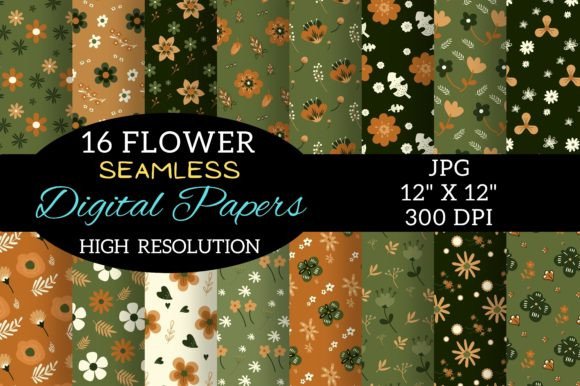
You will receive a total of 16 flower digital paper backgrounds in a single zipped file (38 MB). Each background is delivered as a JPG file—no layered PSDs, no SVGs, no editable vectors. That means immediate usability across platforms: import into Canva, Adobe Photoshop, Affinity Designer, Cricut Design Space, or even Microsoft Word with predictable results.
Each file is sized at 4000 × 4000 pixels—exactly 12 × 12 inches at 300 dpi. This resolution ensures clean, crisp output whether you’re printing on home inkjet paper, professional cardstock, or matte photo paper. No pixelation, no interpolation artifacts, and no need to upscale or resample before sending to press.
How Flowers, Floral Digital Paper Fits Into Real Creative Workflows
These backgrounds are purpose-built for projects where visual cohesion and tactile quality matter. Think handmade birthday invitations printed on textured linen paper, layered scrapbook pages with hand-cut floral accents, or DIY wedding stationery kits assembled from scratch. Because each pattern is uniform in scale and resolution, mixing and matching across layouts remains consistent—unlike sourcing individual floral PNGs, which often vary in size, color balance, and transparency handling.
They’re also well-suited for hybrid analog-digital processes. For example, a teacher designing classroom reward certificates might layer one of these floral papers behind student names in Google Slides, then export as PDF for laser-printed handouts. A small-business owner creating seasonal product labels could use them as base layers in Illustrator, adding custom typography and barcodes without worrying about background distortion.
Strengths Worth Noting
- Print-ready consistency: Uniform dimensions and resolution eliminate guesswork when preparing files for physical output.
- Time efficiency: No need to tile, blend, or adjust repeats—each background is a complete, balanced composition.
- Format accessibility: JPGs open in virtually any software, including free tools like GIMP or Paint.NET, lowering the barrier to entry.
- Thematic versatility: While rooted in florals, the collection includes variations—soft watercolor washes, bold graphic prints, vintage-inspired linocuts—so it supports multiple aesthetics without requiring separate purchases.
Tradeoffs and Limitations to Consider
Because these are JPG files—not vector or layered formats—they aren’t suited for tasks that require editing individual elements. You can’t change the color of a single bloom or isolate a stem for repositioning. If your workflow depends on granular control over components (e.g., swapping out specific flowers per project), you’d be better served by floral clipart bundles with transparent PNGs or vector sets.
Likewise, while the 16 designs offer thoughtful variety, they don’t include seasonal variants (e.g., cherry blossoms for spring, holly for winter) or cultural motifs (e.g., chrysanthemums for East Asian celebrations, marigolds for Día de Muertos). Users needing highly contextual or symbolic flora may need to supplement this set—or choose a more specialized collection.
Another practical consideration: JPGs don’t support transparency. If you plan to overlay text or graphics with soft drop shadows or blending modes that rely on alpha channels, you’ll need to add those effects manually in your editor, or work around the opaque background using masking techniques.
When Flowers, Floral Digital Paper Is the Right Choice
This collection shines in scenarios where speed, reliability, and aesthetic harmony outweigh the need for deep customization. It’s especially valuable if you:
- Regularly produce printed invitations, greeting cards, or gift tags and want cohesive, elevated backdrops without licensing ambiguity;
- Teach art or design and need classroom-friendly assets that load quickly and render consistently across student devices;
- Run a small craft-based business and prefer predictable, royalty-free resources you can confidently reuse across client projects;
- Prefer working in raster-based environments (like Procreate or Photoshop) and value plug-and-play compatibility over vector scalability.
For instance, a freelance calligrapher building a starter kit for wedding clients might use three of these floral papers as envelope liners, place cards, and menu backgrounds—knowing all will align visually and print cleanly at full size.
When You Might Choose Something Else
If your work involves frequent resizing across drastically different outputs—a social media banner (1200 × 628 px), a large-format poster (24 × 36 inches), and a business card (3.5 × 2 inches)—a vector-based floral pattern library would give you sharper scaling and smaller file sizes. Similarly, designers building interactive web experiences or animated presentations may find static JPGs less flexible than SVG or Lottie alternatives.
And if your focus is educational illustration—say, teaching plant anatomy or pollination biology—photographic or scientifically accurate botanical diagrams would serve better than decorative digital paper, no matter how lovely the floral rendering.
Comparing Formats and Use Cases
It’s helpful to think of Flowers, Floral Digital Paper not as a standalone solution, but as one tool among several. Here’s how it stacks up against common alternatives:
- Photographic floral textures: Offer realism but rarely tile seamlessly; often lack the uniform scale needed for repeated backgrounds.
- Free online floral patterns: May be lower resolution, inconsistently licensed, or embedded with watermarks—introducing legal or quality risk.
- Custom-designed floral repeats: Provide full creative control but require time, skill, and software investment—making them impractical for occasional users.
- Subscription-based design asset libraries: Offer breadth and updates but involve recurring cost and potential usage restrictions; not ideal for one-off or budget-conscious projects.
Flowers, Floral Digital Paper occupies a middle ground: more reliable than free sources, more accessible than custom work, and more focused than broad subscription services.
Making an Informed Decision
Ask yourself two questions before choosing this resource:
- Do I need ready-to-print, consistent, floral-themed backgrounds—and am I comfortable working with raster files? If yes, this collection delivers efficiently.
- Do my projects regularly demand transparency, scalability, or element-level editing? If yes, consider pairing this set with supplemental PNG or vector assets—or selecting a different format altogether.
There’s no universal “best” floral digital paper. What matters is alignment with your tools, timeline, output requirements, and tolerance for manual adjustments. Flowers, Floral Digital Paper meets a clear, narrow need well: dependable, beautiful, printable floral backdrops—without overcomplicating the process.