Buffalo Plaid Check Pattern: A Timeless Design Language with Modern Utility
The Buffalo Plaid Check Pattern is more than a nostalgic textile motif—it’s a versatile, scalable visual system rooted in symmetry, contrast, and cultural resonance. Originating in 19th-century woolen mills of upstate New York, its signature oversized, two-color (often red-and-black or navy-and-white) intersecting stripes evolved from functional workwear into a globally recognized design language. Today, designers, educators, product developers, and small-business owners leverage the Buffalo Plaid Check Pattern not just for apparel, but as a foundational graphic asset—especially when high-fidelity, print-ready interpretations are required.
Why This Pattern Endures Across Disciplines
Unlike fleeting trends, the Buffalo Plaid Check Pattern persists because it balances visual clarity with structural predictability. Its grid-based construction—formed by alternating bands of color at consistent intervals—creates inherent rhythm and scalability. At 300 dpi resolution and 12×12 inches (3600×3600 pixels), each pattern tile becomes a self-contained, repeatable unit ideal for seamless tiling across surfaces: fabric yardage, wall murals, packaging substrates, or digital interfaces requiring tactile warmth.
This consistency matters practically. For instance, a textile designer developing a limited-run capsule collection can use one Buffalo Plaid Check Pattern file to preview garment drape in CAD software, generate cutting layouts, and output direct-to-fabric prints—all without distortion or interpolation loss. Similarly, an educator creating classroom posters on American industrial design history benefits from a crisp, artifact-grade rendition that preserves line integrity under projection or high-resolution printing.
Technical Integrity Meets Creative Flexibility
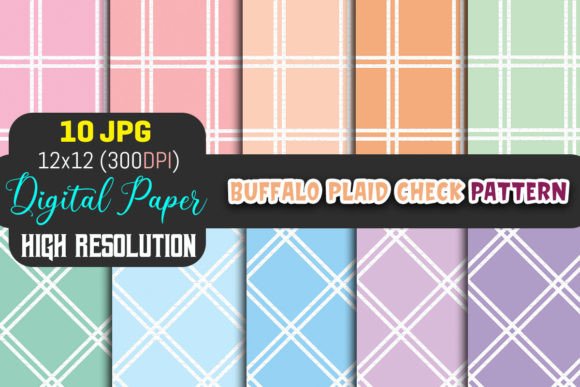
The 10 distinct Buffalo Plaid Check Pattern backgrounds included in this resource were developed using vector-derived raster workflows—ensuring precise alignment, consistent stroke weights, and chromatic fidelity across all variants. Each file avoids algorithmic repetition; instead, subtle variations in stripe proportion, color saturation, and interlacing density distinguish one pattern from another. One may emphasize vertical dominance with 3:1 stripe ratios; another softens contrast through desaturated earth tones while retaining the core plaid logic.
This intentional diversity supports real-world decision-making. A ceramicist applying surface decoration to mugs might select a tighter-scale variant for fine detail retention during decal transfer, whereas a signage contractor installing large-format vinyl wraps would prioritize a bolder, higher-contrast version to maintain legibility at 10-foot viewing distances. The uniform 3600×3600 pixel dimension ensures compatibility with industry-standard RIP (raster image processing) software used in commercial print environments—from DTG (direct-to-garment) printers to wide-format UV-cured systems.
Applications Beyond Traditional Textiles
While historically tied to flannel shirts and lumberjack iconography, contemporary use cases reveal the Buffalo Plaid Check Pattern’s adaptability:
- Product Packaging: A craft brewery launching a seasonal maple stout might integrate a deep burgundy-and-charcoal Buffalo Plaid Check Pattern onto kraft paper labels—evoking heritage while signaling artisanal authenticity without literal illustration.
- Educational Visuals: In STEM curricula, the pattern serves as an intuitive model for teaching tessellation, binary logic (on/off stripe states), or Fourier transforms—its periodic structure makes abstract mathematical concepts visually legible.
- Digital Interface Design: UI designers occasionally employ low-opacity plaid overlays as subtle background textures in dashboard headers or modal windows—adding depth without competing with data visualization elements.
- Architectural Visualization: Interior renderings use scaled-down Buffalo Plaid Check Pattern swatches to represent upholstery or acoustic paneling, offering clients immediate material context before physical samples arrive.
- Research Documentation: Ethnographers studying regional identity markers have referenced plaid variations—including Buffalo Plaid Check Pattern iterations—as nonverbal indicators of community affiliation in archival photo analysis.
Practical Considerations for Implementation
Adopting any Buffalo Plaid Check Pattern requires attention to context—not just aesthetics. First, consider scale relativity: a 12×12 inch tile appears dramatically different when printed at 18 inches tall on a tote bag versus repeated at 0.5-inch intervals on a phone case. Always test at final output size before mass production.
Second, evaluate color mode rigorously. While RGB files suit screen-based previews, CMYK conversion is essential for offset or screen-printed applications. These 10 patterns were pre-validated in both spaces—each JPG embeds ICC profiles appropriate for sRGB (digital) and FOGRA39 (European offset) standards, minimizing unexpected hue shifts during handoff to print vendors.
Third, recognize licensing boundaries. These are original, non-stock interpretations—meaning they carry no third-party restrictions. However, end-use remains the responsibility of the downloader: trademark-sensitive applications (e.g., branding mimicking established outdoor apparel logos) require independent legal review. The patterns themselves are tools—not turnkey brand assets.
How Designers and Makers Leverage These Files Effectively
Professionals rarely use plaid patterns in isolation. Instead, they layer them intentionally. A furniture designer might pair a muted Buffalo Plaid Check Pattern with matte black hardware renderings to emphasize material contrast in client presentations. A maker-space instructor could import one variant into open-source vector software like Inkscape, then use path operations to extract individual stripe bands—transforming the pattern into modular stencils for screen-printing workshops.
Hobbyists benefit equally. Quilters use high-res plaid tiles to digitally audition fabric combinations before purchasing yardage. Teachers print them onto cardstock, cut them into puzzle pieces, and use them to teach symmetry operations (reflection, rotation, translation) in middle-school math units. Even researchers studying visual perception have cited consistent plaid grids like these as reliable stimuli for measuring contrast sensitivity thresholds across age groups.
Understanding Resolution and Output Realities
The specification “300 dpi at 12×12 inches” reflects a deliberate calibration between quality and usability. At this resolution, each linear inch contains 300 pixels—sufficient for sharp edge definition in professional lithographic printing, where halftone dots typically range from 133–200 lpi (lines per inch). Scaling beyond 15×15 inches risks visible pixelation unless resampled using preservation algorithms (e.g., Adobe Photoshop’s Preserve Details 2.0)—but the original files provide headroom for moderate enlargement without degradation.
Crucially, these are not upscaled derivatives. Each was constructed natively at full dimension using pixel-perfect grid alignment—avoiding the softness or artifacting common in AI-enhanced or interpolated assets. That fidelity translates directly to reduced prepress correction time and fewer press checks during physical production runs.
Integration Into Existing Workflows
These Buffalo Plaid Check Pattern files integrate seamlessly into common creative pipelines:
- Adobe Suite Users: Drag-and-drop into Photoshop layers for masking or blending mode experiments; place directly into Illustrator as linked raster objects for compound clipping masks.
- Free & Open Tools: GIMP and Krita support layered PSD imports and offer robust tiling tools—ideal for generating infinite repeats or animated texture loops.
- 3D Modeling: Import as UV-mapped textures in Blender or Fusion 360 to simulate fabric drape over parametric models—valuable for prototyping wearable tech enclosures or ergonomic tool grips.
- Web Development: Convert to optimized WebP or AVIF via Squoosh for CSS background-image declarations—retaining visual richness while meeting Core Web Vitals performance thresholds.
No special plugins or proprietary software are required. The ZIP archive contains only standard JPGs—universally readable, metadata-light, and compatible with every major operating system’s native archive utility. Double-click extraction works reliably on macOS, Windows, and Linux distributions.
Looking Ahead: Pattern Literacy in a Digital Age
As generative tools proliferate, the value of human-curated, context-aware pattern libraries grows—not diminishes. Algorithms can replicate plaid geometry, but they rarely encode the nuanced decisions behind stripe weight hierarchy, chromatic temperature balance, or cultural resonance calibration. These 10 Buffalo Plaid Check Pattern interpretations reflect applied judgment: when to prioritize boldness over subtlety, when optical correction outweighs strict geometric purity, and how to serve both nostalgic appeal and forward-looking functionality.
That balance makes them relevant whether you’re sourcing background textures for a university lecture slide deck, developing inclusive learning materials for neurodiverse students, prototyping sustainable packaging for an eco-conscious startup, or documenting vernacular design traditions for academic publication. The pattern isn’t the endpoint—it’s a reliable, adaptable starting point grounded in decades of iterative refinement.