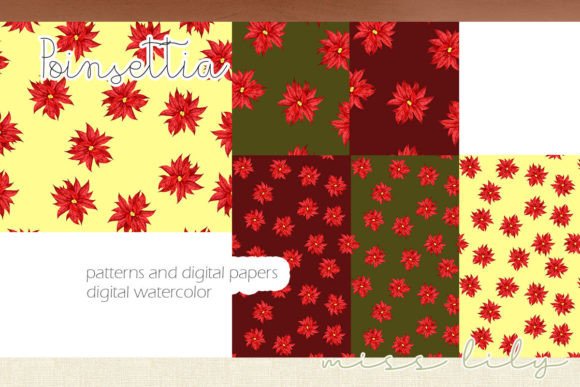
Poinsettia Collection Digital Papers: A Practical Guide for Crafters and Designers
The Poinsettia Collection Digital Papers is a curated set of 18 high-resolution JPEG files, each sized at 30.5 × 30.5 cm (12 × 12 inches) and rendered at 300 DPI in the sRGB color profile. Designed with versatility in mind, this collection blends traditional holiday motifs—centered on the iconic poinsettia—with modern digital workflow needs. Unlike mass-produced seasonal assets, these papers reflect intentional design choices: many are seamless patterns, though some intentionally break seamlessness to serve specific creative purposes like focal-point backgrounds or layered collage elements.
What Sets This Collection Apart
Not all digital paper sets prioritize both aesthetic cohesion and functional flexibility—and that’s where the Poinsettia Collection Digital Papers distinguishes itself. The inclusion of both seamless and non-seamless variants acknowledges real-world usage: seamless patterns excel for repeating backgrounds in scrapbook layouts or printable calendars, while non-seamless designs offer stronger visual anchors for greeting cards or jar labels where a centered motif or subtle asymmetry adds character.
The color fidelity is calibrated for print readiness—not screen flashiness. The sRGB profile ensures consistency across most consumer printers and desktop workflows, though users should still soft-proof before final output. As noted in the listing, reds and pinks may appear more saturated on brighter HDMI displays; this isn’t a flaw but a reminder that digital color is contextual. Managing expectations around monitor variance is part of responsible digital asset use—not a limitation unique to this collection.
Practical Use Cases and Real-World Fit
This collection shines in projects requiring thematic consistency without rigidity. For example:
- Scrapbook layouts: The 12×12” size matches standard album pages, eliminating scaling guesswork. Seamless variants tile cleanly across double-page spreads; non-seamless options work well as full-page backdrops with intentional focal points.
- Greeting cards and invitations: High-resolution JPEGs allow crisp printing even at small sizes—no pixelation when scaled down to 5×7” or 4×6”. The poinsettia theme reads clearly at a glance, supporting seasonal messaging without relying on text.
- Junk journals and recipe cards: Texture, contrast, and motif density vary across the set—some papers feature delicate line work ideal for handwritten notes; others include bolder foliage for visual hierarchy in layered spreads.
- Sticker sheets and gift tags: Because each file is a standalone JPEG, designers can easily isolate sections using selection tools—no need for layered PSDs unless desired. That simplicity lowers the barrier for beginners while remaining efficient for experienced users.
It’s also worth noting the practical advantage of instant digital delivery. There’s no shipping delay, no physical inventory management, and no risk of damaged stock—just immediate access to files you control locally. That’s especially valuable during peak holiday planning windows, when lead time matters.
Comparing Formats and Workflow Needs
Digital papers come in several formats—JPEG, PNG, PSD, TIFF—and each serves different priorities. The Poinsettia Collection Digital Papers uses JPEG, which balances universal compatibility, manageable file size, and print-ready quality. JPEG lacks transparency (unlike PNG), so if your workflow depends heavily on drop shadows or layered overlays without background removal, you’ll need to work around that—either by placing the paper behind other elements or using clipping masks in editing software.
That said, JPEG remains the most widely supported format across platforms—from Canva and Cricut Design Space to Adobe Photoshop and Affinity Publisher. If you’re collaborating with others who use varying software or sharing templates with clients unfamiliar with advanced file types, JPEG reduces friction. It’s not the most flexible format, but it’s reliably functional.
Compare this to vector-based pattern swatches or SVG tile sets: those scale infinitely and support recoloring, but require vector-editing proficiency and don’t convey texture or subtle grain the way raster-based digital papers do. The Poinsettia Collection Digital Papers embraces the tactile authenticity of printed paper—subtle noise, soft gradients, realistic shadowing—all preserved at 300 DPI. That realism supports craft-focused outcomes where “handmade” feel matters more than infinite scalability.
When This Collection Fits—and When It Might Not
The Poinsettia Collection Digital Papers is strongest for users who:
- Need holiday-themed assets with botanical authenticity—not generic snowflakes or cartoonish icons;
- Prefer ready-to-print files over building from scratch or adjusting complex layered files;
- Work across multiple output types (cards, labels, books) and value consistent sizing and resolution;
- Appreciate clarity about technical limits—e.g., knowing up front that colors shift across screens or that not every paper is seamless.
It may be less suitable if you require:
- Transparency for easy compositing (in which case, a PNG version—or supplemental clipart—would fill the gap);
- Custom color matching to brand Pantone values (sRGB doesn’t map directly to CMYK spot colors);
- Extensive variation within a single motif (e.g., 50+ poinsettia variations)—this set offers thoughtful variety, not exhaustive repetition;
- Editable source files (like layered PSDs with individual motif layers), since JPEGs are flattened.
That last point bears emphasis: this is a collection of finished digital papers—not design templates or editable components. Its strength lies in usability, not modifiability. Users seeking maximum control over every element may prefer kits with layered files—even if that adds complexity.
Complementing, Not Replacing, Your Toolkit
The listing mentions matching clipart is available separately. That’s a useful detail—not because the papers depend on it, but because it signals intentionality in ecosystem design. You can use the papers alone for elegant minimalism, or combine them with coordinating elements for richer compositions. That modularity supports decision-making: start simple, then expand only as needed.
Similarly, the note about “honest error” reflects a grounded approach to digital design—acknowledging that screens differ, that printing involves variables beyond file specs, and that creativity thrives within constraints. It’s a quiet reminder that no digital resource eliminates all variables—but the right one minimizes the ones that matter most to your goals.
Making an Informed Choice
If you’re evaluating digital papers for holiday projects, consider three practical filters:
- Output intent: Are you printing at home, sending to a professional lab, or designing for digital-only use? The 300 DPI and sRGB profile of the Poinsettia Collection Digital Papers align well with home and commercial inkjet printing—but less so with large-format signage or web-only graphics where lower resolution would suffice.
- Workflow alignment: Do you rely on transparency, layering, or vector editing? If yes, assess whether JPEGs fit your usual process—or whether supplemental assets (like the mentioned clipart) bridge the gap.
- Thematic precision: Does “poinsettia” serve your audience authentically? For secular or multicultural contexts, broader botanical or winter themes may offer wider resonance. But for traditional holiday crafts—especially those tied to December celebrations—the poinsettia carries clear, warm, and culturally anchored meaning.
In short, the Poinsettia Collection Digital Papers isn’t a universal solution—but it is a considered one. It meets specific needs with clarity, avoids overpromising, and supports thoughtful execution over flashy novelty. For crafters, educators, small-business owners, and designers who value reliability, seasonal relevance, and straightforward integration, it’s a resource that earns its place—not by being everything, but by doing certain things exceptionally well.