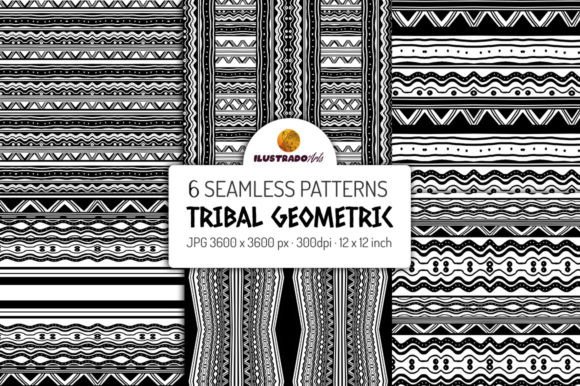
TRIBAL GEOMETRIC SET
The TRIBAL GEOMETRIC SET is a curated collection of six high-resolution, hand-drawn black-and-white digital paper patterns—each rooted in tribal motifs and precise geometric repetition. Designed for immediate integration into creative workflows, this set isn’t just decorative; it’s a functional asset that supports consistency, visual cohesion, and professional output across print and digital mediums. Its 300 dpi resolution, 12×12 inch (3600×3600 px) dimensions, and JPG format ensure compatibility with industry-standard design tools—from Adobe Photoshop and Illustrator to Canva, Procreate, and even desktop publishing software like Affinity Publisher.
Where It Fits in Your Creative Process
Unlike generic pattern libraries, the TRIBAL GEOMETRIC SET bridges planning and execution. You’ll use it early—during mood board assembly or brand identity sketching—to establish tone and texture before committing to color palettes or typography. Or you’ll pull it mid-project: applying one pattern as a subtle background layer behind invitation text, another as a border element on a greeting card, or a third as a repeating motif on a T-shirt mockup. Because each file is hand-drawn—not algorithmically generated—it carries organic variation in line weight and spacing, lending authenticity without sacrificing scalability.
This matters most when workflow speed and visual integrity must coexist. For example, a small business owner designing a product launch campaign can drop a pattern directly into a social media banner, adjust opacity for readability, and export in under two minutes—no tracing, no vector conversion, no licensing ambiguity. Similarly, an educator preparing printable classroom resources can tile one pattern across a worksheet header, reinforcing thematic continuity across lesson materials without slowing down lesson prep.
Integration Across Tools and Platforms
The TRIBAL GEOMETRIC SET works where you already work. Its JPG format ensures seamless import into platforms with limited file support—including email newsletter builders (Mailchimp, Klaviyo), presentation tools (Google Slides, Keynote), and even basic word processors (Microsoft Word, Pages) when used as page backgrounds. In vector-based environments, designers often place a JPG pattern as an embedded reference layer, then trace over it to create scalable versions—preserving the hand-drawn character while gaining editability.
For print production, the 300 dpi resolution meets standard commercial printing requirements. When preparing files for physical products—like foil-stamped wedding stationery or fabric-printed tote bags—you’ll retain crisp detail up to 12×12 inches without interpolation or blurring. If scaling beyond that size, consider using one pattern as a focal repeat (e.g., centered on a book cover) rather than attempting full-bleed tiling at larger dimensions—a practical choice that maintains clarity and avoids unintended pixelation.
Real-World Use Cases by Role
- Freelance designers embed patterns into client presentation decks to demonstrate texture options before finalizing layouts—reducing revision rounds and aligning expectations faster.
- Bloggers and content creators apply a pattern as a consistent header background across blog post thumbnails, Pinterest pins, and YouTube banners—strengthening visual recognition across platforms without custom illustration per piece.
- Small publishers use one pattern as endpaper texture in PDF eBooks or printed chapbooks, adding tactile nuance to otherwise flat digital formats.
- Hobbyists and paper crafters print patterns at home on cardstock, cut them into layered stencils, or scan them into cutting machines (Cricut, Silhouette) for precision die-cutting—turning digital assets into physical components.
- Marketers launching limited-edition merchandise pair a tribal geometric pattern with minimalist typography for cohesive T-shirt, sticker, and tote bag designs—ensuring all touchpoints share a unified, culturally grounded aesthetic.
Preparation and Organization for Long-Term Use
Before importing the TRIBAL GEOMETRIC SET into your library, rename files meaningfully—e.g., “TribalGeometric_Set03_SymmetricalZigzag.jpg”—rather than relying on default numbering. Store them in a dedicated “Patterns/Textural Assets” subfolder within your main design resource directory. This simple step pays off during deadline pressure: when you need a bold, rhythmic motif for a festival poster, you’ll locate it in seconds instead of scrolling through dozens of unrelated downloads.
Consider creating a quick-reference PDF with thumbnail previews and notes on best-fit use cases (e.g., “Set01: Low-contrast, ideal for subtle backgrounds; Set05: High-contrast, works well for apparel graphics”). Keep it open in your workspace while designing—it functions as both a visual index and a decision aid, reducing cognitive load when choosing between options.
Quality Control and Consistency Checks
Because all six patterns are hand-drawn but share a unified stylistic language—consistent line weight range, balanced negative space, and intentional asymmetry where appropriate—they behave predictably across applications. That means if you use Set02 as a border on a wedding invitation and Set04 as a background on the matching RSVP card, the visual relationship feels intentional, not accidental. To maintain that consistency:
- Always preview patterns at 100% zoom before placing—this reveals subtle irregularities that may affect alignment or tiling.
- Test contrast against your primary text color using a soft light or overlay blend mode, especially for invitations or cards where legibility is non-negotiable.
- When using multiple patterns in one layout, limit yourself to two per composition unless there’s a clear hierarchy (e.g., dominant background + secondary accent frame).
Efficiency Without Compromise
Time saved with the TRIBAL GEOMETRIC SET isn’t measured only in minutes—it’s reflected in fewer iterations, more confident client presentations, and tighter brand execution. A freelance illustrator working on a series of cultural storytelling zines might spend hours developing original patterns from scratch. With this set, they gain six professionally rendered starting points—each ready for recoloring, masking, or selective erasure—freeing mental bandwidth for narrative development and composition refinement.
For educators building curriculum-aligned visual aids, the set eliminates the need to search across multiple stock sites for “tribal,” “geometric,” and “black and white” separately—only to find mismatched scales or inconsistent line quality. Here, everything is pre-vetted, uniformly sized, and intentionally restrained in palette—making it easier to uphold accessibility standards (e.g., sufficient contrast for dyslexic readers) without extra testing.
Long-Term Value Beyond the First Project
The TRIBAL GEOMETRIC SET gains utility over time—not because it changes, but because your understanding of how to deploy it deepens. After using Set06 as a textured overlay on a podcast cover, you might later realize its rhythm works equally well as a subtle watermark on digital course materials. Or after applying Set01 to a set of holiday cards, you’ll recognize its modular structure makes it ideal for dividing sections in a workshop workbook.
That adaptability stems from thoughtful construction: each pattern balances repetition with variation, avoiding monotony while remaining easy to crop, rotate, or mirror. It doesn’t demand special plugins, subscriptions, or updates. It lives locally on your machine, performs reliably offline, and integrates cleanly into version-controlled design systems—making it as useful in 2025 as it is today.
Ultimately, the TRIBAL GEOMETRIC SET serves a quiet but essential function: it removes friction between idea and execution. Whether you’re prototyping a new product line, assembling a portfolio, or designing a personal journal, these six patterns offer grounded, human-made texture—ready when you are.