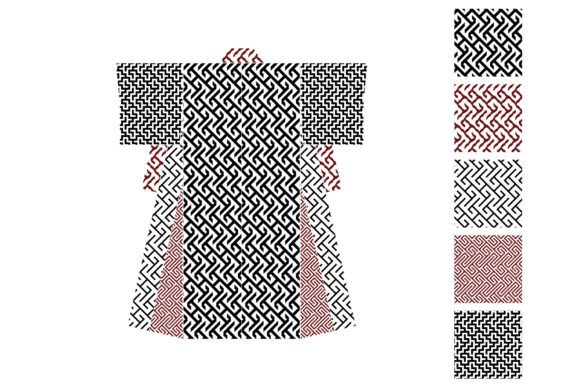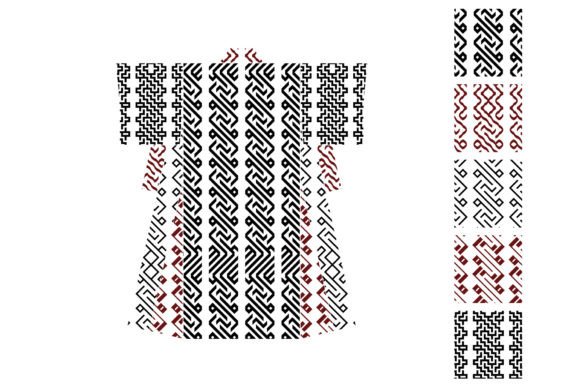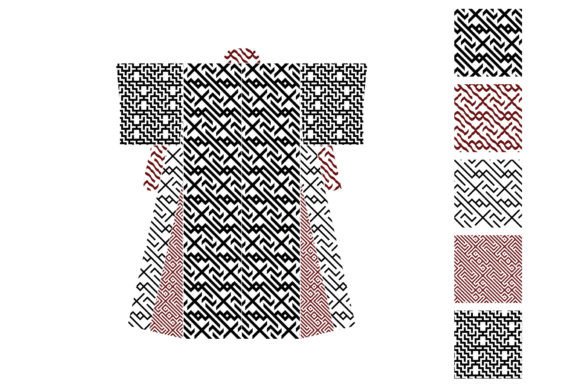
Maze Pattern Set 10: Labyrinth Motifs for Cultural Textile & Interior Design
Imagine tracing a path through centuries of craft—where the winding symmetry of a Korean gaboo motif meets the quiet precision of Japanese wagara, all grounded in the tactile logic of batik resist-dyeing and the crisp geometry of laser-cut aluminum partitions. That’s the quiet power of Maze Pattern Set 10: five AI-generated, EPS-compatible labyrinth patterns designed not as decorative filler, but as structural design language. These aren’t generic swirls or abstract loops. Each maze is balanced, intentional, and deeply rooted in visual traditions—yet engineered for seamless tiling, scalability, and real-world application across textiles, interiors, and digital assets.
What Makes These Mazes Feel Timeless—Not Trendy
Look closely at any pattern in Maze Pattern Set 10, and you’ll notice something subtle: no dead ends. Every path loops, returns, or interlocks—echoing the philosophical underpinnings of East Asian design, where continuity and balance matter more than novelty. The line weight stays consistent across scales, so whether printed on a hanfu sleeve at 3 cm tall or etched onto a 2m-tall room divider, the rhythm holds. There’s no forced “ethnic” stylization—no exaggerated florals or cartoonish dragons. Instead, you get clean, modular labyrinths that nod to chinoiserie framing, Korean munjang borders, and Japanese seigaiha-inspired wave logic—but translated into neutral, adaptable geometry.
This restraint is why designers reach for Maze Pattern Set 10 when they need cultural resonance without cliché. A Seoul-based boutique uses one variant as a repeat for hanbok lining—not as the focal print, but as a whisper of heritage beneath a bold modern cut. A Kyoto tatami studio applies another as a subtle embossed border on custom mat edges, visible only when light hits at a low angle. It’s design that serves, rather than shouts.
Where These Patterns Earn Their Keep (Beyond the Obvious)
Yes, they work beautifully on kimono fabric, cheongsam collars, and batik scarves—that’s expected. But their real versatility shows up where precision and repetition matter most:
- Laser-cut partitions: The clean vector paths translate flawlessly to CNC and laser files. One architect used Pattern #3 to create a room-dividing screen with alternating open/cut pathways—functional airflow + visual rhythm.
- Tatami and flooring accents: Because each maze tiles seamlessly, it avoids the “jarring seam” problem common with complex repeats. No awkward breaks at wall junctions or under furniture legs.
- Digital texture overlays: When layered at 8–12% opacity in editorial layouts or social media banners, they add depth without competing with typography—especially effective for heritage brands launching limited-edition collections.
- Packaging foil stamping: The uniform stroke width ensures crisp results even in fine-detail hot-foil applications on rigid boxes or textile tags.
What doesn’t work? Trying to force them into small-scale UI icons or micro-printed labels under 4 mm. These are macro-scale patterns—they breathe best at 15 mm minimum repeat size. Respect their scale, and they reward you with cohesion.
Practical Integration: Testing, Pairing, and Licensing Reality Checks
Before dropping Maze Pattern Set 10 into your next project, run three quick checks:
- Test the tile boundary: Open one EPS in Illustrator, enable “View > Show Grid” and “View > Snap to Grid”, then duplicate and align. Does the edge match perfectly? All five patterns do—but always verify, especially if you’re adjusting stroke width manually.
- Check contrast against substrate: Print a 10×10 cm swatch on your actual fabric or material. A maze that reads clearly on cotton voile may vanish on brushed aluminum or matte ceramic tile. Adjust line weight *before* production—not after.
- Review licensing scope: These are commercial-use patterns, but the license covers physical products (apparel, partitions, stationery) and digital deliverables (websites, social posts, presentations). It does *not* cover resale as standalone digital pattern packs or embedding in SaaS design tools. If you’re building a client-facing design platform, contact the provider directly for extended rights.
For pairing: avoid competing geometric textures. Don’t layer Maze Pattern Set 10 over houndstooth, argyle, or dense damask. Instead, pair it with solid fields, subtle tonal gradients, or organic linocut-style illustrations. On a hanfu jacket, let the maze live only on the cuff band or inner lapel—keeping the main body fabric uncluttered. In interior mockups, use it on one surface only: ceiling panels, a single accent wall, or cabinet fronts—not every vertical plane.
Why This Set Fits Designers Who Value Craft Over Convenience
There’s a quiet confidence in choosing Maze Pattern Set 10. It signals you’ve looked past algorithmically generated “Asian-inspired” clipart and invested in motifs built on actual compositional discipline. You’re not just decorating—you’re referencing lineage. That matters to clients who commission bespoke cheongsams for weddings, or architects specifying cultural centers, or publishers designing art books on textile history.
It also saves time in revision cycles. Because the patterns are vector-based and EPS-compatible (CS6+), there’s no pixelation, no font substitution warnings, no missing layers. Your printer, embroiderer, or laser-cutting vendor receives clean, production-ready files—no back-and-forth about resolution or embedded raster images.
And unlike many “cultural” design assets, these don’t flatten tradition into ornament. They invite interaction: trace the path with your eye, follow the loop, pause at the implied center. That subtle engagement—calm, focused, unhurried—is rare in today’s visual landscape. It’s why a Tokyo branding studio uses Pattern #2 as a watermark on pitch decks: not for flash, but for quiet authority.
If your work bridges heritage and contemporary practice—if you design for people who care about how a pattern feels in the hand, how it holds up under wear, how it reads across cultures and contexts—then Maze Pattern Set 10 isn’t just another download. It’s a calibrated tool. One that works as hard as you do.