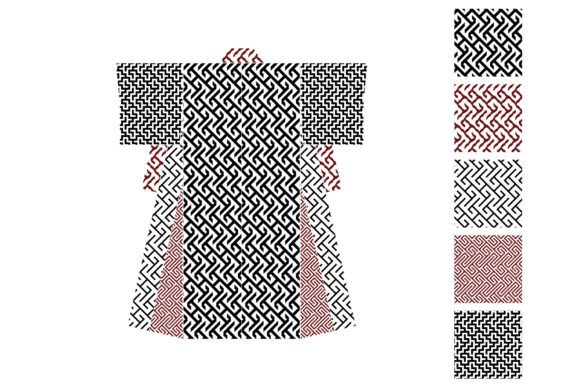
Maze Pattern Set 7: A Versatile Toolkit for Cultural Textile & Interior Design
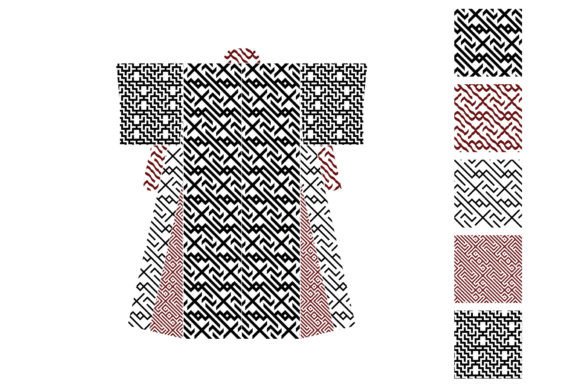
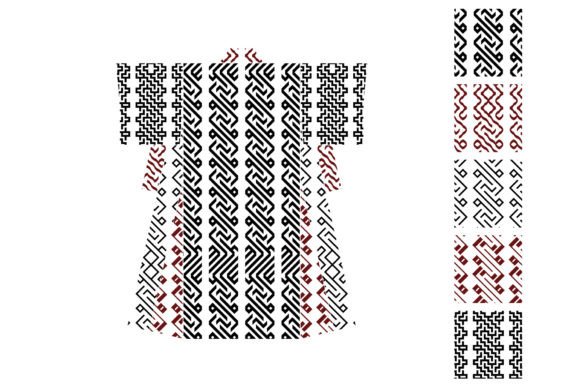
For designers, artisans, and interior professionals seeking authentic yet adaptable visual language, Maze Pattern Set 7 stands out—not as mere decoration, but as a bridge between ancient symbolism and modern application. This curated collection merges the meditative logic of labyrinth motifs with time-honored East Asian aesthetics, offering five AI-compatible EPS maze patterns designed explicitly for seamless integration into textile, architectural, and product design workflows.
What Makes Maze Pattern Set 7 Distinctive?
Unlike generic geometric repeats, each pattern in Maze Pattern Set 7 is built on layered cultural syntax: subtle nods to Chinese yunlei wen (cloud-and-thunder motifs), Korean gobun symmetry, Japanese wagara rhythm, and the restrained elegance of traditional hanfu and cheongsam borders. These aren’t pastiches—they’re reinterpretations grounded in proportion, balance, and spatial intentionality.
The set includes:
- Five original maze-labyrinth designs—each fully scalable, vector-based, and compatible with Adobe Illustrator CS6 and newer versions;
- Seamless tiling capability optimized for repeat across fabric widths, wall panels, and laser-cut sheets;
- Intentional negative space—designed to support dyeing techniques like batik, shibori, and block printing without visual clutter;
- Cross-cultural adaptability: patterns harmonize with tatami mat borders, kimono obi bands, hanbok sleeve trims, and cheongsam collar accents;
- Technical readiness for industrial use—clean anchor points, minimal anchor count, and CMYK-optimized paths for print production.
Why Labyrinth Motifs Resonate Across Cultures
Mazes are rarely just puzzles. In Chinese tradition, they echo the Bagua’s cyclical flow; in Korea, they appear in folk embroidery as protective “spirit traps”; in Japan, they mirror the winding garden paths of Zen temples—inviting contemplation over navigation. Maze Pattern Set 7 honors that depth. Its pathways avoid rigid grids, instead using gentle curves and rhythmic interruptions that echo hand-drawn brushwork—making it feel human-made, not algorithmically generated.
Practical Applications: Where These Patterns Come Alive
Maze Pattern Set 7 isn’t confined to digital mockups. Its real value emerges in physical execution—and across disciplines.
Fabric & Apparel Design
For batik artists, the clean line weight and open structure of these mazes allow wax resist to adhere evenly, minimizing bleeding during dye immersion. Designers creating modern hanfu or hanbok use them as subtle all-over grounds—scaled down for collar linings or enlarged for full-sleeve motifs. Kimono studios apply them to obi end panels where repetition must read cohesively at arm’s length.
Interior Architecture & Spatial Design
When translated into aluminum partitions or laser-cut room dividers, the maze geometry creates dynamic light play—shifting shadows throughout the day without compromising privacy. Architects specify Maze Pattern Set 7 for hospitality lobbies where cultural resonance matters: a Seoul boutique hotel uses one variant behind reception as a backlit scrim; a Kyoto ryokan integrates another into custom tatami edging strips, reinforcing traditional craftsmanship through contemporary form.
Product & Surface Design
From ceramic tile series to lacquered furniture inlays, these patterns scale reliably from 2 cm² to 2 m². Their balanced density prevents visual fatigue—ideal for large-format wall cladding or elevator interiors. One U.S.-based studio recently adapted a maze variant for a modular acoustic panel system, where the path layout subtly guides sound diffusion while maintaining aesthetic continuity.
Who Benefits Most—and How to Assess Fit
Maze Pattern Set 7 serves three primary user groups—but suitability depends on project goals, not just role.
- Small-batch textile creators appreciate its ready-to-sew scalability and compatibility with DTG printers and screen-printing stencils. If your workflow involves frequent size adjustments or colorway swaps, the EPS format saves hours versus redrawing from raster files.
- Interior designers and architects rely on its precision for fabrication specs—especially when coordinating with metal fabricators or CNC workshops. The absence of embedded fonts or raster effects means no last-minute file conversion surprises.
- E-commerce brand owners use these patterns to unify visual identity across product categories: matching wallpaper, throw pillows, and packaging—all derived from one consistent motif family.
That said, Maze Pattern Set 7 isn’t ideal for every need. It does not include photorealistic textures, PANTONE libraries, or animated variants. It assumes foundational vector literacy—users should know how to adjust stroke weight, expand appearances, or convert strokes to outlines. And while culturally informed, it avoids literal iconography (no dragons, cranes, or phoenixes); its strength lies in abstraction, not illustration.
Getting Started: A Realistic Workflow Example
Consider a designer developing a limited-run cheongsam collection inspired by Shanghai’s historic lilong alleyways. They begin by importing one maze pattern into Illustrator, then:
- Adjust tile spacing to match standard silk width (140 cm), ensuring seam alignment across front/back panels;
- Apply a duotone gradient mimicking ink wash tones—using the pattern’s inherent contrast to guide color placement;
- Export swatches for both digital sampling (PDF proof) and physical test prints on habotai;
- Collaborate with a Shanghai-based batik workshop, sharing the vector file directly—eliminating pixelation concerns during stencil cutting.
This process took under two days—versus the week typically needed to manually adapt non-seamless motifs. That efficiency compounds across collections, seasons, and client revisions.
Looking Beyond the File: Context Matters
Using Maze Pattern Set 7 thoughtfully means understanding what the patterns *don’t* say as much as what they do. They carry no prescribed meaning—no mandated auspiciousness, no fixed seasonal association. That openness is intentional. It invites designers to layer their own narrative: a Tokyo-based ceramics brand overlays one maze with gold leaf to evoke kintsugi philosophy; a Jakarta studio pairs it with indigo dye to reference shared Austronesian trade routes with China and Korea.
This flexibility is why educators incorporate Maze Pattern Set 7 into design foundation courses—it demonstrates how structure supports expression, how restraint enables reinterpretation, and how technical precision can serve cultural sensitivity.
A Final Note on Longevity
Trends fade. But well-considered pattern systems endure. Maze Pattern Set 7 was created with longevity in mind—not as a “trend pack,” but as a foundational resource. Its compatibility with emerging tools (like AI-assisted colorization plugins or AR fabric previewers) has been validated in beta testing. More importantly, its visual grammar remains legible whether viewed on a smartphone screen, printed on silk, or cut from 3mm aluminum.
If you’re evaluating whether Maze Pattern Set 7 fits your next project, ask yourself: Does this need quiet sophistication over loud novelty? Does it benefit from cross-cultural resonance without cliché? Will it be reproduced across multiple materials and scales? If yes—this set isn’t just useful. It’s quietly essential.