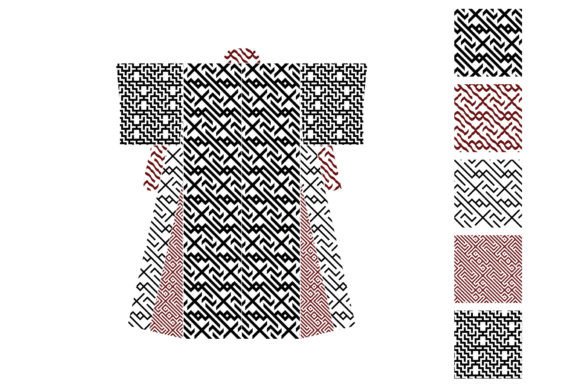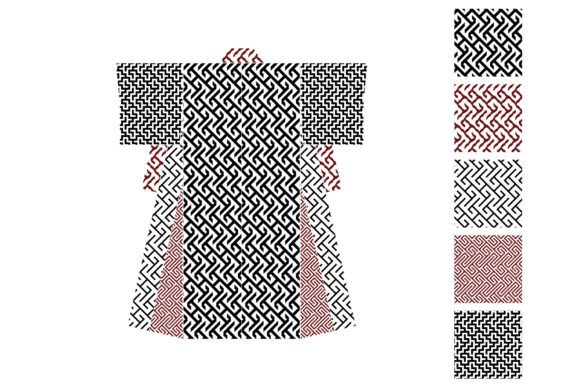
Maze Pattern Set 5: Labyrinth Designs for Textile & Interior Art
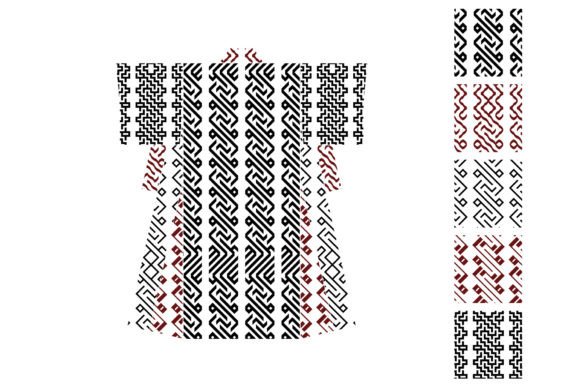
Imagine tracing a path through a hand-drawn labyrinth—then scaling it across silk for a modern cheongsam, etching it into aluminum for a minimalist office partition, or repeating it seamlessly across tatami mats. Maze Pattern Set 5 delivers exactly that: five meticulously crafted, AI-generated maze and labyrinth patterns in EPS format, fully compatible with Adobe Illustrator CS6 and newer. These aren’t decorative filler—they’re functional design assets built for precision, repetition, and cultural resonance.
What Makes This Set Distinctive
Unlike generic geometric repeats, each pattern in Maze Pattern Set 5 balances complexity with clarity. Lines are clean but not sterile—there’s subtle rhythm in the turns, intentional asymmetry in some layouts, and consistent stroke weights that hold up whether scaled to 2 cm for embroidery or 2 m for wall cladding. All five patterns are vector-based, infinitely scalable, and designed as seamless swatches—meaning they tile without visible seams, essential for batik printing, textile repeats, or laser-cut paneling.
The set bridges tradition and technical utility. One pattern evokes the meditative flow of Japanese wagara, another echoes the structured symmetry of Korean munjang (traditional motifs), while a third suggests the layered symbolism of Chinese cloud-and-coin labyrinths. None appropriate cultural forms superficially; instead, they reinterpret structural logic—paths, boundaries, thresholds—in ways that feel authentic and adaptable.
Creative Applications Across Mediums
Designers working across disciplines will find immediate utility:
- Textile & Apparel: Use the seamless swatches directly in Illustrator’s Swatch Library to fill kimono sleeve panels, cheongsam collars, or hanbok skirt bands. For batik, isolate individual maze segments to serve as resist outlines—then dye around them for layered depth. A medium-weight maze works especially well for woven cotton hanfu linings, where subtlety reads as texture rather than motif.
- Interior Surfaces: Apply patterns to laser-cut aluminum partitions by importing EPS files into CAD software—maintaining crisp edges at any scale. For tatami or cork flooring, repeat the swatch across large-format print files (300 DPI, CMYK) to create quiet, grounding floor patterns that guide movement without overwhelming space.
- Digital & Print Media: Bloggers illustrating mindfulness themes can embed a simplified maze as a background element behind quotes—its structure subtly reinforces ideas of journey and reflection. Educators designing worksheets on spatial reasoning or cultural studies can extract single-path versions (using Illustrator’s Pathfinder) for student tracing exercises.
Adapting for Different Audiences and Goals
A small business owner launching a line of ceramic tea sets might use one maze pattern as a subtle rim motif—repeating it only once per cup, then varying line thickness to echo traditional celadon crackle. That same pattern, when enlarged and embossed onto leather journal covers, becomes tactile and contemporary. The key is intentionality: ask *what role does the maze play here?* Is it structural framing? Cultural nod? Rhythmic background? Or literal navigation aid—as in wayfinding signage for a wellness center?
Freelance illustrators can deconstruct the EPS files: ungroup layers to separate outer borders from inner paths, recolor segments for duotone effects, or overlay with halftone textures for vintage poster looks. Marketers building brand identity around “clarity through complexity” might animate a single maze path unfurling across social banners—using the vector precision to ensure smooth SVG rendering.
Hobbyists and educators benefit most from the set’s accessibility. No need for advanced coding or plugin knowledge—just open Illustrator, drag the EPS file into your artboard, and apply it as a swatch. To keep results organized, name layers clearly (“Maze_03_Seams_Off”, “Maze_01_Border_Only”) and save variants as separate .ai files. Consistency emerges not from rigid rules, but from thoughtful reuse: same pattern, different scale, different context.
Practical Tips for Stronger Results
Start simple. Before layering effects or blending modes, test how a pattern reads at actual size—print a 10×10 cm swatch to assess legibility and rhythm. For textile work, check how the repeat aligns across seam allowances; adjust tile dimensions in Illustrator’s Pattern Options panel if needed.
When adapting for cultural garments, avoid direct replication of sacred or ceremonial motifs (e.g., specific Shinto or Confucian symbols). Instead, focus on shared structural values: balance in Korean dancheong painting, restraint in Japanese shibori composition, or continuity in Chinese feng shui pathways. Maze Pattern Set 5 supports that respectful reinterpretation because its forms are abstracted—not literal copies.
For laser-cut metal or wood, confirm line weights meet manufacturer minimums (typically 0.08–0.1 mm for fine cuts). Simplify overly dense sections using Illustrator’s Simplify tool—preserve the path’s logic, not every micro-turn. And always export final production files as outlined strokes, not live effects.
Why This Set Fits Real Creative Workflows
This isn’t about adding “more patterns” to your library. It’s about having five reliable, production-ready starting points that respond to real constraints: tight deadlines, client revisions, material limitations, or cultural sensitivity requirements. A blogger needing a visual metaphor for problem-solving doesn’t need 50 options—they need one clean, scalable maze that conveys progression without confusion. An interior designer specifying custom partitions needs vectors that import cleanly into AutoCAD or Fusion 360—no raster conversion, no pixelation.
The value lies in what you do with the patterns—not just what they look like. One user printed Maze_04 onto removable vinyl for temporary gallery wall dividers, adjusting opacity to 15% so it receded behind artwork. Another embedded Maze_02 into a Shopify product page as an animated SVG background—subtle motion reinforcing the brand’s theme of “guided discovery.”
That kind of flexibility comes from intelligent design—not trend-chasing. Maze Pattern Set 5 assumes you know your audience, your medium, and your purpose. It gives you tools calibrated for clarity, not noise.
Getting Started Today
Open Illustrator. Load the EPS files. Try applying one as a fill to a rectangle—then scale it up and down. Notice how the negative space shifts, how density changes perception. Then ask: Where does this belong? On fabric? Metal? Screen? In education? In branding? Let the answer guide your next step—not the other way around.
Because strong design doesn’t begin with decoration. It begins with direction—even in a maze.